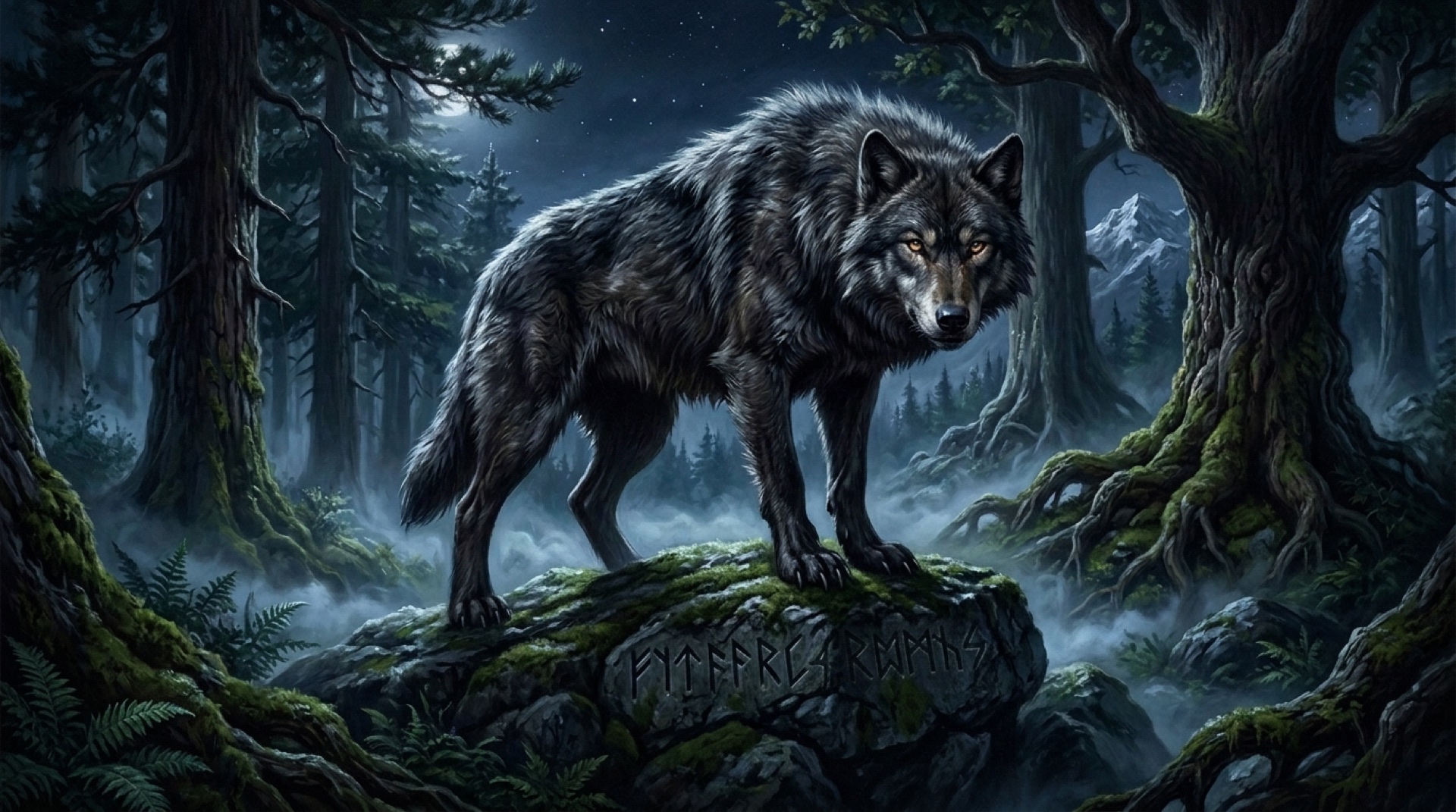
The Warg: Ancestry of a Legend
An investigation into the Indo-European roots, Germanic outlawry codes, Eddic wolf-lore, and J. R. R. Tolkien’s philological revival of the great wolf of the North.
I The Word in the Dark: Etymology, Outlawry, and the Germanic Wolf
Long before the word warg entered modern fantasy literature, it carried a chilling double edge across the early Germanic world—denoting both a ravenous wolf and a condemned human outlaw cast beyond the protection of law and kin. Historical linguists trace the word to the Proto-Germanic masculine noun *wargaz, itself derived from the Proto-Indo-European verbal root *werǵʰ- (or *h₂werǵʰ-), meaning “to turn, twist, press, constrict, or strangle” (Online Etymology Dictionary; Kroonen 2013). From the same root comes Modern English worry—whose earliest Old English sense (wyrgan) meant to seize by the throat and strangle, just as a wolf dispatches its prey.
Across the medieval Germanic languages, *wargaz diverged into two closely intertwined semantic streams—one preserving the legal and moral horror of the strangler or accursed felon, and the other transferring that dread onto the apex predator of the northern forests:
“Strangler, evildoer, criminal, outlaw; destructive wolf.” Derived from PIE *werǵʰ- (“to constrict, choke”).
Both “wolf” (originally a taboo-avoidance name for úlfr) and “outlaw, sacral violator, peace-breaker” (Cleasby & Vigfusson).
“Outcast, accursed felon, monster, malignant being” (Bosworth-Toller). Preserved in compounds like weargrod (“gallows”).
OHG warg (“strangler, fiend, outlaw”); Latinized Frankish wargus (“expelled outlaw”) in the 6th-century Lex Salica.
In early Germanic legal tradition, this equation of criminal and wolf was literalized in law. When a man committed an unatoneable crime—such as murder in a sacred precinct or desecrating a grave—he was pronounced a wolf. The 6th-century Frankish Pactus Legis Salicae (§55.4) decrees: “Wargus sit, hoc est expulsus” (“Let him be a wargus, that is, an outcast”). In medieval Icelandic law (Grágás), a sanctuary-violator was declared vargr í véum (“a wolf in the holy places”) and sentenced to skóggangr (“forest-going”)—banished into the deep woods where, like a wolf, he could be hunted without legal penalty.
In Old Norse, úlfr was the ordinary zoological word for the gray wolf, whereas vargr carried a darker, violent charge—functioning both as a hunter’s euphemism (a linguistic noa-name used to avoid speaking the wolf’s true name aloud) and as the poetic designation for monstrous or mythic wolves. Over centuries in Sweden, this taboo substitute completely displaced ulv, so that varg remains the standard modern Swedish word for wolf today. In Anglo-Saxon England, conversely, wulf remained the animal’s name while Old English wearh (or wearg) narrowed to mean an “accursed villain” or “monster”—Memorably applied in Beowulf to Grendel’s mother as a heorowearh (“sword-accursed wolf/outcast,” line 1267) and grundwyrgen (“accursed she-wolf of the depths,” line 1518).
II Hounds of Shadow: J. R. R. Tolkien’s Wargs in Middle-earth
The modern revival of Warg as a proper name for a distinct, intelligent, and malevolent breed of giant wolf-like beasts is entirely the work of J. R. R. Tolkien (1892–1973). As Rawlinson and Bosworth Professor of Anglo-Saxon at the University of Oxford, Tolkien was intimately familiar with both Old English wearh and Old Norse vargr. Rather than inventing a random fantasy word, he deliberately fused the phonetic form of Old Norse with the sinister moral weight of Old English.
“Warg: this form of the word for ‘wolf’ in old Germanic languages (ON vargr, OE wearg, OHG warg) is used for an evil breed of (demonic) wolves; the name is adopted from Old Norse vargr, which had the special sense ‘outlaw’ in addition to ‘wolf’.”
— J. R. R. Tolkien, The Letters of J. R. R. Tolkien, Letter #297 (Draft to “Mr. Rang,” August 1967)
Within the internal philology of Middle-earth—explained in The Peoples of Middle-earth (The History of Middle-earth, Vol. XII)—Tolkien presented Warg as a word belonging to the Northern Mannish tongues of Wilderland (the language of the Beornings and Woodmen along the river Anduin), representing an archaic northern cognate to Old English wearh.
Crucially, in Tolkien’s fictional world, Wargs are never portrayed as ordinary wild animals acting on mere predatory instinct. Across his major works, they exhibit three defining characteristics:
1. Sentient Malice and Language (The Hobbit, 1937): In Chapter 6 of The Hobbit (“Out of the Frying-Pan into the Fire”), Bilbo, Gandalf, and the Dwarves are trapped in pine trees by a great pack of Wargs from over the Misty Mountains. Tolkien explicitly notes that these wolves speak a “dreadful language” of their own—which Gandalf understands—and gather in forest clearings to deliberate over raids, politics, and vengeance.
2. Calculated Military Alliance with Orcs: Unlike natural wolves, Tolkien’s Wargs form deliberate pacts with Goblins and Orcs. In The Hobbit, they plan joint raids on the wood-men’s villages and carry Goblin warriors on their backs into the Battle of Five Armies. In The Lord of the Rings (The Two Towers), Saruman deploys regiments of Orcish Warg-riders as fast-moving cavalry scouts and shock troops across the plains of Rohan.
3. Demonic & Spectral Lineage (The Fellowship of the Ring & The Silmarillion): In The Fellowship of the Ring (Book II, Chapter 4, “A Journey in the Dark”), the Company is assailed at night beneath the withered trees of Hollin by a pack of Wargs led by a great chieftain. Although Legolas slays many with his bow and Gandalf drives them back with fire, when daylight returns, every slain body has vanished without a trace—leaving only Legolas’s scorched arrows on the turf. Gandalf concludes they were no ordinary wolves, but “Hounds of Sauron.” Within Tolkien’s broader Silmarillion mythology, such creatures trace their ancestry to the First Age, when Morgoth bred giant wolves in Angband and inhabited them with evil spirits—most famously Draugluin, sire of the werewolves, and Carcharoth (“The Red Maw”), the colossal wolf who guarded the gates of Angband.
III Fenrir, the Ironwood, and the Wolf-Steeds of Northern Myth
Tolkien’s conception of the Warg draws its deepest atmospheric resonance from the wolf-lore of the Old Norse Poetic Edda (compiled in the 13th-century Codex Regius from older oral poetry) and Snorri Sturluson’s Prose Edda (c. 1220). In Norse cosmology, monstrous wolves—repeatedly called vargar in the original Icelandic verses—are agents of cosmic dread, cunning speech, and apocalyptic ruin:
Fenrir (Fenrisúlfr / Hróðvitnir): Born of the trickster god Loki and the giantess Angrboða in Jötunheimr, Fenrir grows so rapidly and ominously that the Æsir gods can only bind him by commissioning the dwarven fetter Gleipnir (forged from impossible things: the sound of a cat’s footfall, the beard of a woman, the roots of a mountain). Suspicious of treachery, the intelligent wolf refuses to let the ribbon be placed upon him unless one of the gods places a hand inside his jaws as a pledge of good faith. Only Týr dares do so, losing his right hand when the fetter tightens (Encyclopædia Britannica: Fenrir; Gylfaginning ch. 34). At Ragnarök, Fenrir breaks his bonds, his lower jaw scraping the earth and his upper jaw against the sky, to devour Odin.
The Brood of Járnviðr (“Ironwood”) and the Vargöld: Beyond Fenrir himself, the Eddic poem Völuspá (stanzas 40–41) describes an ancient giantess dwelling east of Midgard in a dark, primeval forest called Járnviðr (“Ironwood”). There she breeds Fenrir’s monstrous wolf-kin—including Sköll and Hati Hróðvitnisson, the wolves that relentlessly pursue the Sun and Moon across the sky, and Mánagarmr, who feeds on the lifeblood of dying men and swallows the heavenly bodies. In stanza 45 of Völuspá, the seeress names the final epoch of moral and social collapse before the end of the world the vargöld—literally the “Warg-Age” or “Wolf-Age”: “Vindöld, vargöld, áðr veröld steypisk” (“A wind-age, a wolf-age, before the world falls headlong”).
The Kveldriður and Wolf-Riders of the Sagas: Even the motif of riding giant wolves has an authentic precedent in Old Norse myth and skaldic poetry. In Norse folklore, troll-women, giantesses (gýgjar), and night-riding witches (kveldriður, “evening-riders,” or myrkriður, “dark-riders”) use giant wolves as their mounts, bridling them with venomous serpents. When the goddess Nanna’s funeral ship is too heavy for the gods to launch in Gylfaginning (ch. 49), the giantess Hyrrokkin arrives from Jötunheimr riding a giant wolf with vipers for reins. The image was so widespread in Viking Age culture that it was carved onto the 10th-century Hunnestad Monument runestone (DR 284) in southern Sweden, and Snorri’s Skáldskaparmál lists “troll-woman’s steed” (hestr gýgjar) as a standard poetic kenning for a wolf.
IV Weighing the Evidence: Documented Influences vs. Mythic Parallels
In tracing the genealogy of a legend, scholarship requires separating what is directly documented in primary sources from broader structural similarities and uncertain or modern pop-culture conflations. Use the filter controls below to inspect each connection by its evidentiary standing:
Evidence: Directly confirmed by Tolkien himself in Letters #297 (1967) and The Peoples of Middle-earth. Tolkien explicitly adopted the word from Old Norse vargr (“wolf” + “outlaw”) and Old English wearh (“accursed felon”) to signify that his Wargs were not ordinary fauna, but demonic, outlaw wolves.
Evidence: Directly attested in Tolkien’s Oxford lectures and translations of Beowulf (published in Beowulf: A Translation and Commentary). The poem’s use of wearh/wyrgen for Grendel’s kindred as intelligent, malignant outcasts haunting the wilds directly informed Tolkien’s monstrous taxonomy.
Evidence: Well-established in Tolkien scholarship (Shippey 2005; Garth 2003). In The Silmarillion, the great wolf Carcharoth bites off the hero Beren’s right hand as Beren holds aloft a Silmaril—a direct mythic reworking of the Eddic account of Fenrir biting off Týr’s right hand during his binding.
Assessment: Tolkien knew the Eddic and skaldic motif of troll-women and giantesses riding wolves (e.g., Hyrrokkin in Gylfaginning and Helgakviða Hjörvarðssonar). However, while Norse myth portrays solitary giantesses bridling wolves with snakes, Tolkien reimagined the concept into organized cavalry alliances between packs of speaking Wargs and Goblin/Orcish riders.
Assessment: Both Völuspá’s Járnviðr and Tolkien’s Wilderland/Mirkwood eaves feature a dark eastern forest teeming with a supernatural breed of giant wolves (called vargar in Völuspá). While Tolkien’s familiarity with Völuspá is certain (he adapted Dwarven names directly from it), he did not leave an explicit note equating Mirkwood’s Wargs 1-to-1 with Járnviðr.
Assessment: Although modern roleplaying games and adaptations sometimes equate Wargs with prehistoric Ice Age dire wolves (Aenocyon dirus), there is no documentary evidence that Tolkien based Wargs on North American fossil canids. Tolkien consistently framed Wargs through Germanic philology and demonology rather than paleontology.
Assessment: The modern usage of warg as a noun or verb for a human who telepathically enters the mind of a wolf or animal originated with George R. R. Martin’s A Game of Thrones (1996). Neither historical Old Norse nor Tolkien’s legendarium used vargr/warg in this telepathic sense (Old Norse used hamrammr, “shape-strong,” or úlfhéðnar, “wolf-coats,” for shape-changers and wolf-warriors).
V Primary & Scholarly Sources
- Tolkien, J. R. R. (1981). The Letters of J. R. R. Tolkien, ed. Humphrey Carpenter with Christopher Tolkien. London: George Allen & Unwin. Letter #297 (August 1967 draft to “Mr. Rang,” defining Warg via ON vargr, OE wearg, and OHG warg). Summary & citations at Tolkien Gateway: Wargs.
- Tolkien, J. R. R. (1937; rev. 1951). The Hobbit, or There and Back Again, Chapter 6 (“Out of the Frying-Pan into the Fire”); and (1954) The Fellowship of the Ring, Book II, Chapter 4 (“A Journey in the Dark”).
- Cleasby, Richard & Gudbrand Vigfusson (1874). An Icelandic-English Dictionary. Oxford: Clarendon Press. Entry for vargr (“wolf; outlaw, criminal, vargr í véum”).
- Bosworth, Joseph & T. Northcote Toller (1898/1921). An Anglo-Saxon Dictionary. Oxford University Press. Entry for wearh / wearg (“an accursed one, outlaw, felon, monster”).
- Kroonen, Guus (2013). Etymological Dictionary of Proto-Germanic. Leiden: Brill. Reconstruction of Proto-Germanic *wargaz (“strangler, criminal”) and PIE root *werǵʰ-; see also Online Etymology Dictionary: worry & *wargaz.
- The Poetic Edda (Völuspá) & Snorri Sturluson’s Prose Edda (Gylfaginning). Accounts of Fenrir, the binding with Gleipnir, Týr’s hand, the wolf-brood of Járnviðr, Hyrrokkin’s wolf-mount, and the vargöld (“Wolf-Age”). Accessible via Encyclopædia Britannica: Fenrir and World History Encyclopedia: Fenrir.
- Shippey, Tom (2005). The Road to Middle-earth: How J. R. R. Tolkien Created a New Mythology (3rd ed.). Boston: Houghton Mifflin; and Gerstein, Mary R. (1974), “Germanic Warg: The Outlaw as Werewolf,” in Myth in Indo-European Antiquity, ed. G. J. Larson, University of California Press, pp. 131–156.